
What if the code powering your SaaS launch is the same tool an attacker uses to dismantle it? Functional software isn't necessarily secure software. In 2024, valid credential abuse served as the initial access vector in 30% of security incidents. If you're building in public, a Free Public GitHub Repository Scan is the critical first step to ensure your credentials aren't part of that statistic. You've likely accelerated development using AI assistants, but that speed often creates a dangerous gap between a working prototype and a production-ready application. Machine identities now outnumber human ones by 80 to 1, and many of these are hard-to-manage secrets hiding in your commits.
You're right to worry about data breaches and the hidden risks in AI-generated blocks. There's rarely enough time for a manual security audit when a launch deadline looms. This article shows you how to bridge the gap between "it works" and "it's safe." We'll explore how to uncover hidden vulnerabilities and provide a concrete roadmap to a secure production environment. By the end, you'll have the actionable steps needed to move from uncertainty to a verified, clean bill of health for your repository.
Key Takeaways
- Execute a Free Public GitHub Repository Scan to immediately detect exposed credentials and the critical entry points most frequently targeted by SaaS attackers.
- Expose the security gaps inherent in AI-built codebases where automated tools often leave hardcoded test tokens and secrets in your production logic.
- Master the distinction between visible credential leaks and the deeper architectural vulnerabilities that threaten your data integrity at scale.
- Follow a methodical step-by-step guide to auditing your repository and translating complex technical findings into a clear, actionable remediation plan.
- Discover why a successful scan is only the baseline for security and how to transition to full launch readiness with a comprehensive risk report.
What is a Free Public GitHub Repository Scan?
Your public repository is a beacon. If you believe your code remains invisible because your SaaS hasn't officially launched, you're making a dangerous assumption. Automated scrapers index GitHub every second, hunting for the one mistake that grants them total entry. A Free Public GitHub Repository Scan serves as your first line of defense. It's an automated process designed to audit your public code for exposed credentials and known vulnerabilities before an attacker finds them. This isn't just a suggestion for modern builders; it's a requirement for survival.
This process is fundamentally different from standard code reviews. While a developer looks for logic and performance, a Free Public GitHub Repository Scan looks for secrets. It identifies the critical gap between functional code and production-ready software. Many builders rely on the myth of security through obscurity, hoping their small project won't be noticed. In reality, public repositories are the most common entry point for SaaS attackers. They provide a clear map of your infrastructure, including your API keys and database schemas. If it's on GitHub, it's already being watched.
The Anatomy of a Repository Scan
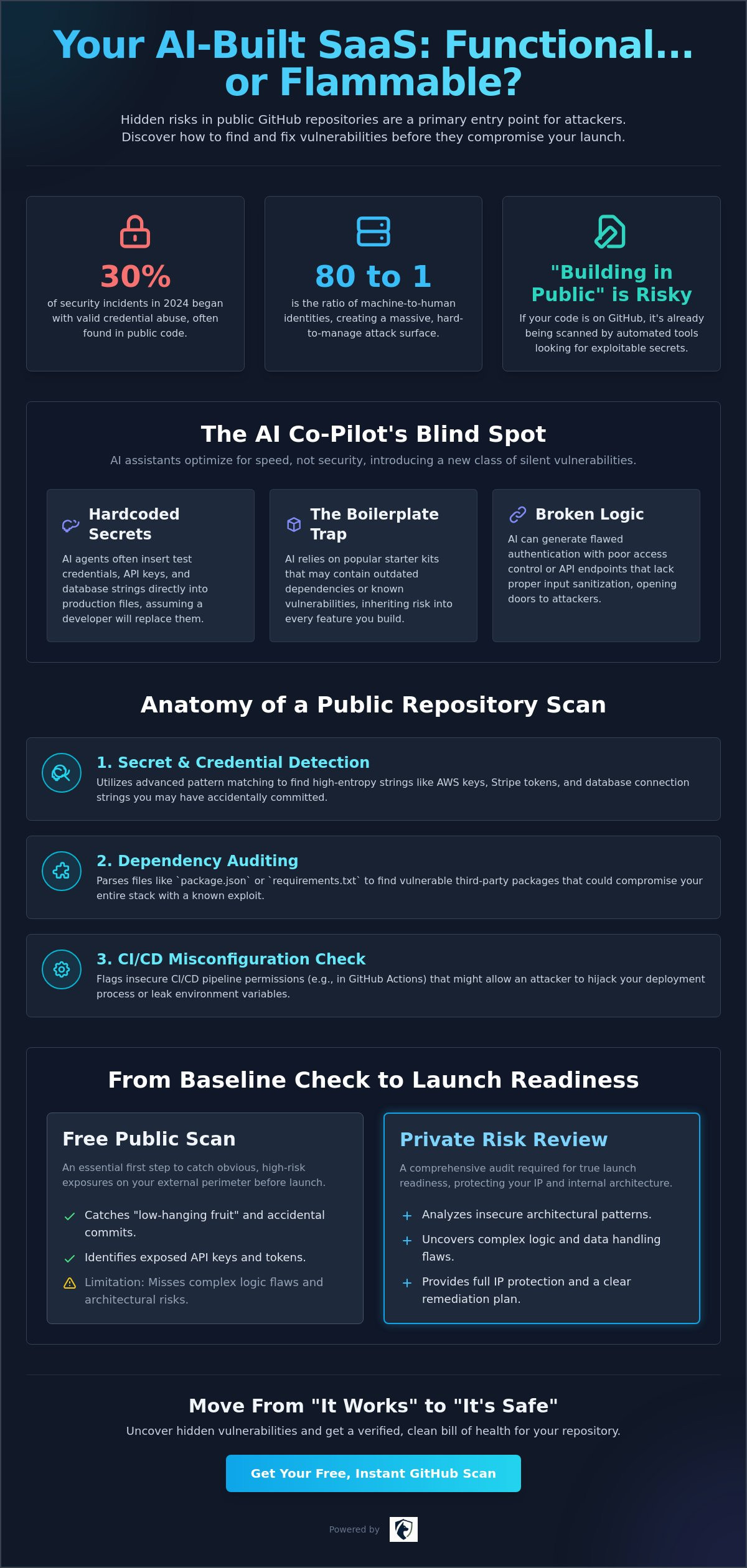
A thorough scan operates on three distinct levels to ensure structural integrity. First, it uses pattern matching to identify high-entropy strings like AWS keys, Stripe tokens, and database connection strings. Second, it performs dependency auditing. It parses files like package.json or requirements.txt to find vulnerable third-party packages that could compromise your entire stack. Finally, it flags misconfigurations in your CI/CD pipelines. It looks for insecure GitHub Actions permissions that might allow an attacker to hijack your deployment process or leak environment variables.
Limitations of Free vs. Paid Scans
Free scans are excellent for catching low-hanging fruit. They'll find the API key you accidentally committed last night. However, they have hard limits. Most free tools focus on surface-level strings and miss complex logic flaws or insecure architectural patterns. While a public scan secures your external perimeter, a Private Repository Risk Review is necessary for full IP protection. You can't stop at the visible layer. True launch readiness requires looking deeper into how your code handles data behind closed doors. A green checkmark on a public repo doesn't mean your private architecture is bulletproof.
The Critical Risks of AI-Built SaaS Codebases
AI coding assistants have transformed the speed of software development, but they've also introduced a new, silent class of vulnerabilities. Many AI coding assistants prioritize generating functional code over secure code. They operate on a completion-first logic. This means they often bypass complex security protocols to deliver a working UI or a functional endpoint quickly. When you use these tools, you aren't just building faster; you're often accumulating technical debt that manifests as high-risk security gaps.
One of the most dangerous patterns is the AI hallucination of safe test data. AI agents frequently insert hardcoded credentials, API keys, or database strings into production-ready files, assuming the developer will replace them. Too often, these secrets remain. A Free Public GitHub Repository Scan is the only way to catch these agent-style oversights before they're indexed by malicious scrapers. These agents also fall into the Boilerplate Trap. They rely on popular SaaS starter kits that may contain outdated dependencies or known vulnerabilities. If your AI-built app is based on a flawed foundation, every feature you build inherits that risk.
Understanding How to Perform a Free GitHub Security Audit is essential for anyone using LLM-based development workflows. These audits reveal the visibility of your code's internal logic. Without this check, you're essentially launching a product with a smoke detector that was never actually plugged in. Automated scanning identifies the specific patterns where AI agents favor speed over structural integrity.
Security Flaws in AI-Generated Code
AI-generated authentication modules are notorious for broken access control patterns. They might verify a user's identity but fail to restrict what that user can actually do within the database. Similarly, AI-generated API endpoints often lack proper input sanitization, leaving your SaaS open to injection attacks. AI agents often prioritize functionality over security protocols. This functional bias creates a false sense of stability. You see a working login page; a technical auditor sees an open door to your customer data.
Why Founders Need a Second Opinion
You cannot trust an AI to fix its own security flaws. If an LLM generated an insecure pattern, it's likely to overlook that same pattern during a self-review. Founders must bridge the gap between "it works" and "it is secure." This requires a strategic partner that sees what the AI overlooked. Using an AI-Built SaaS Launch Readiness Report provides that necessary final check. It moves your project from a state of uncertainty to one of verified readiness. Don't let a functional prototype mask a structural failure. Secure your launch by validating every line the AI wrote.
Public Leaks vs. Private Architectural Risks
A clean scan result often creates a false sense of security. While a Free Public GitHub Repository Scan excels at identifying the visible layer, such as API keys, bearer tokens, and hardcoded credentials, it cannot detect the structural rot beneath the surface. Attackers don't just hunt for keys. They look for architectural weaknesses. A repository might be free of secrets but riddled with insecure database schemas or broken logic. You must understand that a green report on your public files is merely the start of your security journey, not the finish line.
The difference lies in visibility. Visible leaks are usually accidents; architectural risks are often design failures. If your public repo reveals how your API handles requests, an attacker can infer how to bypass your private authentication layers. Transitioning from simple vulnerability scanning to holistic risk management means looking at your code as a complete system. Following the OWASP GitHub Security Guide helps you move beyond the surface. It ensures your workflows and repository settings don't provide a map to your internal infrastructure.
Identifying Authentication Gaps
Public scans often provide hints about deeper flaws in your private codebase. For example, if your public repository contains configuration files that expose how user roles are defined, an attacker can target Broken Object-Level Authorization (BOLA). This is a vulnerability where a user accesses data they don't own by simply changing an ID in a URL. These gaps are rarely caught by automated string matching. To truly secure your application, you need to focus on identifying authentication gaps in code. This involves auditing how your private modules enforce permissions at the database level. It ensures that functional code doesn't become a liability.
Preventing SaaS Data Leaks
Think of your public repo scan as an early warning system. It detects the smoke before the fire spreads to your production environment. However, security isn't a one-time event. Implementation of Scheduled Repository Monitoring ensures that as your team pushes new features, no new leaks are introduced. A single leaked environment variable can compromise your entire user database. This is a binary reality. You are either secure or you are exposed. By maintaining a vigilant watch over your public presence, you protect the private data that your customers entrust to your SaaS. Don't wait for a breach to discover that your "clean" scan was only looking at the surface.
How to Perform a Free GitHub Security Audit
Clicking a button is easy. Understanding the output is what separates a founder from a victim. Many builders treat security as a box to check at the end of the development cycle. This is a mistake. Running a Free Public GitHub Repository Scan is your baseline entry requirement, but the data it produces requires a methodical approach to be useful. You don't need to be a security engineer to secure your SaaS, but you do need to follow a disciplined workflow that translates technical findings into business protection.
When you receive your results, prioritize them with binary logic. Critical findings demand immediate remediation; they're the open doors to your infrastructure. Informational findings often highlight architectural smells that could become liabilities as you scale. Integrating this visibility into your daily development routine ensures that security moves at the same pace as your features. Don't wait for a scheduled audit to find a leak that has been public for months. Run your Free Public GitHub Repository Scan now to establish your security baseline.
The 5-Step Audit Workflow
- Clean your history: Deleting a file from your latest commit doesn't remove it from Git history. Use tools to purge sensitive strings from every previous snapshot.
- Execute the scan: Run the Free Public GitHub Repository Scan to identify immediate red-flag leaks like AWS keys or database connection strings.
- Audit the architecture: Review the SaaS security checklist for founders to find the gaps that automated string matching might overlook.
- Apply Repair Guidance: Don't just identify the hole; patch it. Use structured fix packets to rotate compromised keys and update vulnerable dependencies.
- Verify the fix: Re-scan the repository to ensure the vulnerability is gone and no new issues were introduced during the repair.
Best Practices for Public Repositories
Prevention is always more efficient than remediation. Use a robust .gitignore file to ensure environment variables and local secrets never reach your remote repository. You should also enable native GitHub secret scanning alerts for an additional layer of automated defense. These tools act as a persistent smoke detector for your public presence. However, if your core intellectual property lives in restricted files, a public scan isn't enough. You must trigger a Private Repository Risk Review for your core IP to ensure your proprietary logic isn't hiding structural failures. Security is a continuous process of verification, not a one-time event.
Beyond Free Scans: Achieving SaaS Launch Readiness
Passing a Free Public GitHub Repository Scan is a necessary milestone, but it is not a victory. It represents only 20% of the total security journey. A "green" result simply means you aren't leaking secrets in the most obvious way possible. It doesn't mean your architecture can withstand a targeted attack or that your private logic is sound. For founders, the gap between a clean public repo and a production-ready SaaS is where most catastrophic failures occur. You need more than a surface-level check to protect your reputation and your users.
Investors and early adopters look for structural integrity rather than just functional features. They value transparency and verified safety. Using Client-Ready Code Risk Reports allows you to prove your commitment to security with technical data, not just vague promises. This documentation transforms a potential technical liability into a strategic competitive advantage during due diligence. It shows you've moved from a state of uncertainty to one of verified readiness. You're no longer just a builder; you're a responsible operator.
The Launch Readiness Framework
The Launch Readiness Framework moves you from automated detection to Repair Guidance. It's about providing direction, not just raw data. For non-technical founders, the AI-Built SaaS Launch Readiness Report provides the vocabulary needed to speak "security" with authority. You aren't just fixing bugs; you're creating a "Security Story" for your first 100 customers. This narrative of vigilance builds the trust necessary for long-term market growth. It ensures your team stays focused on building features while your security posture remains uncompromised.
Post-launch, the risks only evolve and intensify. Implementing Scheduled Repository Monitoring ensures that the security posture you established at launch doesn't degrade as you push new features. It acts as a persistent guardian for your infrastructure, catching regressions before they become breaches. This continuous cycle of verification is what separates professional software from hobbyist projects. You can't afford to look away once the first user signs up.
Securing Your Future with AbyssGuard
A Private Repository Risk Review goes deeper by auditing the core logic that a public scan cannot reach. Getting a professional SaaS security audit before your first user signs up is the only way to verify your actual readiness. It's a strategic move that protects your future IP and customer data from day one. Don't launch on a foundation of "hope." Verify your code, secure your infrastructure, and build with absolute confidence. Your Free Public GitHub Repository Scan is the first step, but it must not be your last. Secure your SaaS today. Run your Free Public GitHub Repository Scan now.
Secure Your Code, Validate Your Launch
Speed shouldn't come at the cost of structural integrity. You've built your SaaS to solve a problem, but a single leaked secret can turn your solution into a liability. A Free Public GitHub Repository Scan provides the visibility you need to identify immediate risks like hardcoded credentials and exposed API keys. This is especially critical for projects utilizing AI coding agents, where functional code often masks deep security oversights that can be exploited in seconds.
True readiness goes beyond a surface-level check. You need actionable direction to transition from a vulnerable state to a verified production environment. AbyssGuard offers specialized scanning for AI-built codebases and provides actionable repair guidance that empowers founders to fix holes immediately. Our investor-ready launch readiness reports ensure you can prove your security posture to stakeholders with total clarity. Don't leave your launch to chance. Run Your Free Public GitHub Repository Scan Now and move forward with the confidence that your infrastructure is as solid as your vision.
Frequently Asked Questions
What is the difference between a public and private GitHub scan?
Public scans target repositories visible to anyone, focusing on exposed credentials that scrapers index instantly. Private scans, such as our Private Repository Risk Review, audit internal logic and proprietary IP behind closed doors. While public scans secure your external perimeter, private reviews protect the core architecture from structural failures. You can't rely on a "green" public result to guarantee that your internal data handling is secure.
Can a free scan find security flaws in code written by Cursor or ChatGPT?
Yes, a Free Public GitHub Repository Scan identifies common "agent-style" mistakes such as hardcoded API keys and insecure boilerplate patterns. AI tools prioritize speed, often leaving credentials in production files that developers overlook. A scan acts as a necessary second opinion to catch these functional hallucinations before they're indexed by automated scrapers. It bridges the gap between a working prototype and a production-ready application.
What should I do if a scan finds an exposed API key in my history?
Revoke the compromised key immediately and rotate it to a new, secure value. Simply deleting the file isn't enough because the secret remains embedded in your Git history. You must purge the string from all previous commits and snapshots using specialized tools. Failure to clean your history leaves a permanent map for attackers to reconstruct your credentials through historical analysis of your repo.
Is a free GitHub repository scan enough for a SaaS launch?
No, a Free Public GitHub Repository Scan is merely the baseline entry requirement. It catches "low-hanging fruit" like exposed strings but ignores deep architectural flaws like broken access control or insecure database schemas. To achieve true launch readiness, you need an AI-Built SaaS Launch Readiness Report. This comprehensive audit examines the authentication layers and data handling protocols that automated string matching frequently misses.
How does AbyssGuard identify authentication gaps that other tools miss?
We go beyond simple string matching to analyze how your code enforces permissions at the database level. While standard tools look for keys, we look for logic flaws like Broken Object-Level Authorization (BOLA). Our process identifies structural rot where a user could potentially access data they don't own. We provide the technical depth required to see vulnerabilities that surface-level scanning tools simply cannot detect.
Do I need to be a developer to understand the security report?
No, our reports are designed specifically for founders and non-technical stakeholders. We provide Repair Guidance and Fix Packets that translate complex technical vulnerabilities into actionable steps. You'll receive a clear roadmap to remediation that allows you to manage security risks without needing to write the underlying patches yourself. It's about providing direction and clarity so you can lead your project with verified confidence.
Is it safe to give a scanning tool access to my GitHub repository?
Security tools require read-only access to analyze your code, but you must verify the provider's integrity. We use secure OAuth protocols to ensure we only see the code necessary for the audit. Establishing this visibility is a binary choice: you either verify your safety or remain blind to potential exploits. A reputable tool acts as a vigilant guardian, not an additional point of risk.
How often should I run a security scan on my SaaS codebase?
You should run a scan every time you push new code to production. Continuous integration of Scheduled Repository Monitoring ensures that as your team adds features, you aren't inadvertently introducing new leaks. Security isn't a one-time event; it's a persistent operational requirement. Regular scanning prevents the accumulation of technical debt and keeps your SaaS production-ready in a fast-moving, high-stakes environment.