

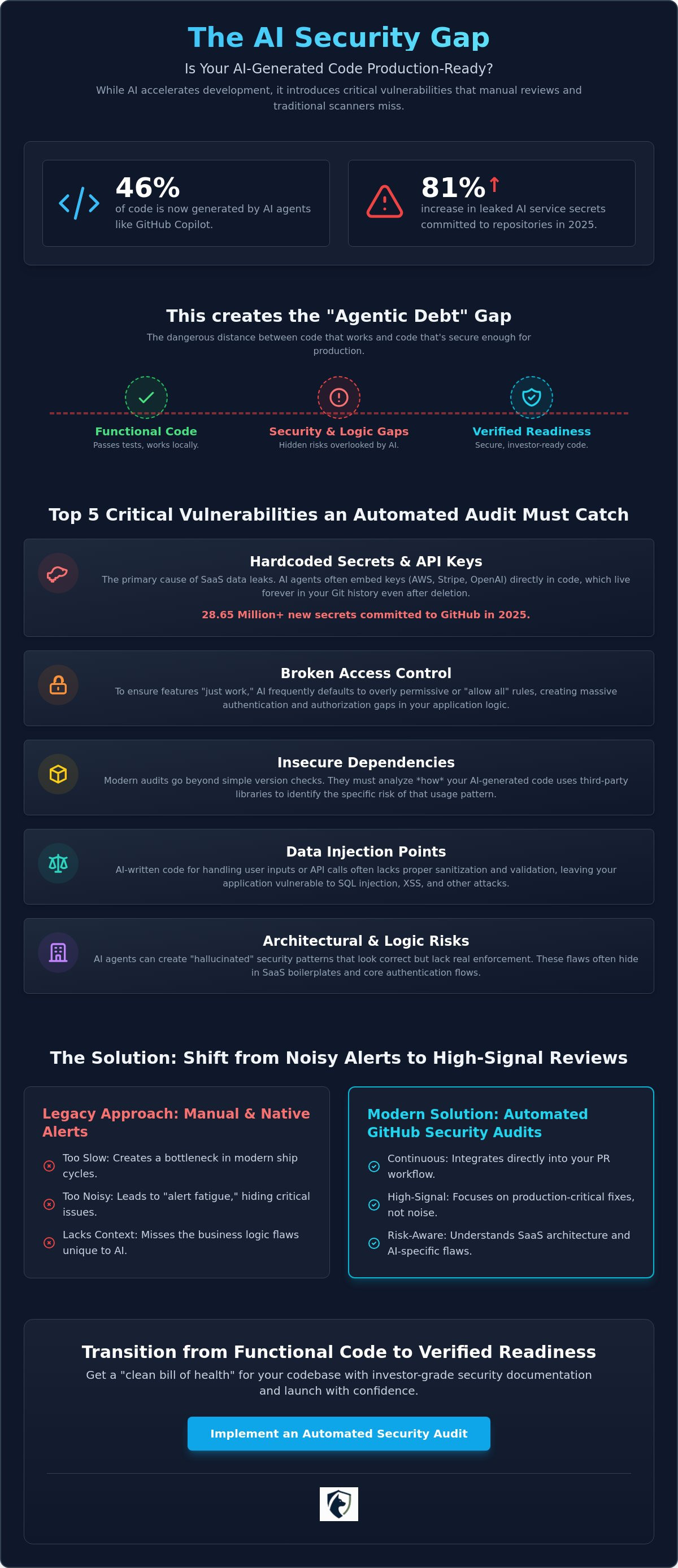
Your AI coding agent is shipping code faster than your team can vet it, and it's likely hallucinating critical vulnerabilities directly into your production branch. While GitHub Copilot now generates 46% of the code in enabled repositories, it also contributed to a staggering 81% increase in leaked AI service secrets in 2025. You've likely realized that manual code reviews are too slow for weekly ship cycles and native alerts are often too noisy to be useful. It's a dangerous gap between functional code and secure, production-ready software.
You deserve a "clean bill of health" for your codebase that doesn't require a total development freeze. By implementing a rigorous automated GitHub security audit, you can catch the logic gaps and authentication failures that AI agents leave behind. This article will show you how to build a "secure by default" workflow that provides investor-ready security documentation and verified readiness. We'll examine the specific configurations needed to bridge the visibility gap and ensure your 2026 SaaS launch is backed by structural integrity rather than just speed.
Key Takeaways
- Identify the critical shift from legacy static analysis to risk-aware reviews that catch the logic gaps AI coding agents frequently overlook.
- Uncover the five most common vulnerabilities, including hardcoded secrets and broken access control, that threaten AI-generated SaaS codebases in 2026.
- Establish an automated GitHub security audit pipeline within your PR workflow to maintain development speed without compromising data integrity.
- Differentiate between noisy native GitHub alerts and high-signal risk reviews to eliminate alert fatigue and focus on production-critical fixes.
- Transition from functional code to verified readiness using an AI-Built SaaS Launch Readiness Report to provide investor-grade security documentation.
What is an Automated GitHub Security Audit?
Your codebase is growing at a rate that human reviewers can't match. If you're using AI agents to accelerate development, you're likely generating thousands of lines of code every week. While this code might pass your functional tests, it hasn't necessarily been vetted for production safety. An automated GitHub security audit is a programmatic review of code, configurations, and dependencies designed to identify risks without human intervention. It serves as a continuous guardrail, ensuring that every commit meets a baseline of structural integrity before it ever reaches a staging environment.
In 2026, the definition of an audit has shifted. It's no longer enough to perform basic pattern matching. Modern audits focus on "Risk Context," understanding not just that a piece of code exists, but how it interacts with your specific SaaS architecture. This process involves a comprehensive analysis of source code to detect vulnerabilities that traditional linters miss. Manual reviews fail to scale because they're too slow for modern ship cycles; they become a bottleneck that developers eventually bypass. The core objective of automation is to move your project from "functional code" to "verified production-ready code" without sacrificing your deployment velocity.
The Anatomy of a Modern Automated Audit
A robust audit isn't a single scan. It's a multi-layered defensive strategy. This includes Static Application Security Testing (SAST) to find logical flaws and Secret Detection to prevent the exposure of API keys. With the rise of cloud-native SaaS, Infrastructure as Code (IaC) scanning is now mandatory to ensure your environment configurations aren't leaking data. Most importantly, these audits must analyze logic and authentication flows. This is the specific area where machine-generated code often fails, creating "hallucinated" security patterns that look valid but lack actual enforcement.
Why 2026 Requires a Different Approach
We've entered the era of "Agentic Debt." This refers to the security flaws introduced by AI coding assistants that prioritize speed over safety. Traditional scanners often miss context-specific SaaS vulnerabilities because they don't understand the intent behind the code. Generative agents might create a perfectly functional webhook, but they frequently default to "allow all" permissions or skip critical validation steps. You can't rely on tools designed for a pre-AI world to protect a codebase built by machines. The AI Security Gap is the distance between code that works and code that is safe.
The 5 Critical Vulnerabilities Automated Audits Must Catch
Your AI coding agent is a speed machine, but it lacks a moral compass for security. While it churns out functional code, it frequently ignores the structural guardrails required for production. A generic scan won't save you from logic-based failures. You need an automated GitHub security audit that specifically targets the nuances of modern SaaS development. Without this level of scrutiny, you're likely sitting on one of these five critical vulnerabilities that can sink a launch before it begins.
First, hardcoded secrets and API keys remain the primary cause of SaaS data leaks. In 2025, developers added 28.65 million new hardcoded secrets to GitHub commits, marking a 34% increase from the previous year. AI service secrets alone reached over 1.27 million leaks. Second, broken access control is rampant because AI agents often default to "allow all" permissions to ensure a feature functions during initial testing. Third, insecure dependencies go beyond outdated versions; you must monitor how your code actually uses these libraries to identify usage risk. Fourth, data injection points emerge when AI-generated inputs lack proper sanitization. Finally, architectural risks often hide within the SaaS boilerplates used to jumpstart development. By integrating security into development iterations, you can catch these flaws before they become permanent liabilities.
Secrets and Credential Leakage
Committing a .env file to your repository is a death sentence for a startup. Automated detection must look for AWS, Stripe, and OpenAI keys immediately. Deleting the line isn't enough; the "Commit History" trap means those keys live forever in your Git history until the entire ref is purged. If you aren't sure what's hiding in your history, a free public GitHub repository scan can provide immediate visibility into your current exposure.
Authentication and Authorization Gaps
AI agents frequently create "Shadow Admin" routes. These are administrative endpoints that function perfectly but lack any authorization middleware. You might also find flawed JWT implementations or session management logic that allows for account takeovers. A functional API endpoint is a liability if it remains unprotected. Your automated GitHub security audit must verify that every route is explicitly gated by your identity provider and follows the principle of least privilege.
Native GitHub Security vs. Automated Risk Reviews
Turning on GitHub’s native security features feels like a victory, but it’s often a false sense of security for SaaS founders. Dependabot and native secret scanning are excellent for catching low-hanging fruit, yet they lack the context required to protect complex business logic. These tools operate on pattern matching. They alert you to known CVEs in your dependencies or obvious strings in your commits. However, they're blind to the architectural hallucinations of an AI agent that builds a functional but insecure multi-tenant database structure. You can't rely on a tool that only looks for what's already known to find the unique flaws your specific AI-generated code has introduced.
Alert fatigue is the silent killer of development velocity. Native alerts often create a high volume of noise, flagging non-critical updates that don't actually impact your attack surface. This noise buries the signal of genuine threats. In contrast, a professional automated GitHub security audit prioritizes risk context over simple version numbers. It moves beyond identifying that a library is old to verifying if your code actually exposes the vulnerable part of that library. When you're preparing for a major milestone, a dashboard full of unpatched "moderate" alerts won't satisfy a sophisticated stakeholder. You need a Client-Ready Code Risk Report that translates technical data into a clear statement of verified readiness.
When Native Tools Are Enough
Native tools serve a purpose for public repositories or early-stage hobby projects. They provide a baseline for dependency tracking and catch obvious syntax-level errors through simple linting. If your project doesn't handle sensitive user data or proprietary algorithms, these basic checks might suffice. They're the starting line, not the finish line. They ensure you aren't shipping the most obvious mistakes, but they won't protect your core IP from sophisticated logic-based exploits.
The Need for Deep Risk Analysis
For any SaaS handling core intellectual property, basic scanning is insufficient. You must audit private repositories with the same rigor as public ones. An automated GitHub security audit provides the depth needed for an AI-Built SaaS Launch Readiness Report. This documentation is essential for satisfying investors or enterprise procurement teams who demand more than just a "green" Dependabot tab. Implementing Scheduled Repository Monitoring ensures that as you scale, your security posture doesn't drift into a state of unverified risk as new AI-generated features are merged.
How to Implement a Security Audit Workflow Without Slowing Down
Speed is the lifeblood of a SaaS startup, but unverified speed is a liability. You don't have to choose between shipping fast and shipping secure code. The friction usually comes from manual reviews that can't keep pace with the sheer volume of machine-generated commits. By implementing a systematic automated GitHub security audit, you replace human bottlenecks with programmatic guardrails. This approach allows your team to maintain their velocity while ensuring that every deployment meets a strict standard of structural integrity.
To build an effective workflow, follow these five steps:
- Step 1: Baseline Risk Assessment. Connect your repository for a Private Repository Risk Review to map out the technical debt and vulnerabilities already present in your legacy or AI-assisted code.
- Step 2: PR Workflow Integration. Integrate automated scans into your pull request process. This ensures that security checks happen as code is written, not as an afterthought.
- Step 3: Establish a Security Gate. Set clear thresholds for production deployments. If a PR introduces a critical risk, the gate prevents the merge until the issue is addressed.
- Step 4: Utilize Repair Guidance. Don't just find problems; provide solutions. Use automated Fix Packets to give developers the exact remediation steps they need to resolve vulnerabilities in minutes.
- Step 5: Continuous Monitoring. Security isn't a one-time event. Schedule continuous monitoring to catch new risks that emerge as your dependencies evolve or new attack vectors are identified.
Integrating with AI Coding Tools
Your developers are likely using generative assistants to write code at an unprecedented scale. These tools are excellent at writing functional logic but often hallucinate insecure patterns or skip essential validation steps that a human might catch. You must audit this code before it ever reaches your main branch. By setting up automated feedback loops, you can flag these errors during the development phase. Automated audits act as a "security linter" for AI agents, catching machine-generated flaws before they become permanent parts of your infrastructure.
From Detection to Repair
Detection is only 20% of the battle. Identifying a vulnerability is useless if your team spends days debating the fix or researching the root cause. This is where the gap between visibility and readiness is bridged. Using automated Fix Packets allows your team to accelerate remediation without extensive research. This reduces your "Time-to-Fix" metric, which is a vital indicator of your project's overall health. If you want to move from uncertainty to verified readiness, you can start with a Private Repository Risk Review to secure your core IP today.
Achieving SaaS Launch Readiness with AbyssGuard
Most tools on the market stop at finding bugs. They provide a list of vulnerabilities but leave you in a state of uncertainty regarding your overall project health. AbyssGuard is different. We move beyond simple pattern matching to provide a comprehensive automated GitHub security audit that focuses on launch readiness. It's the difference between having a list of problems and having a verified path to production. When your codebase is built by AI agents, you need more than a scan; you need a strategic partner that understands the gap between code that runs and code that is secure.
Your intellectual property is your most valuable asset. A Private Repository Risk Review ensures that your core logic, proprietary algorithms, and sensitive configurations remain protected from the structural flaws AI often introduces. We provide the direction required to transition from a state of unverified risk to one of structural integrity. This isn't just about data; it's about providing the visibility you need to lead your development team with authority and confidence.
The Launch Readiness Report
Investors and enterprise clients don't care about your Jira backlog. They care about verified safety. They want to see that your SaaS is built on a secure foundation before they commit capital or sign a contract. Our AI-built SaaS Launch Readiness Report provides "Client-Ready" documentation that speaks the language of stakeholders. It distills complex technical risks into clear, actionable metrics of readiness. There is a profound psychological benefit to achieving a "Clean Scan" before a major launch. It removes the nagging doubt that a hidden vulnerability might derail your release or compromise your first users.
Continuous Monitoring for the AI Era
In a world of daily deployments, a one-off audit is obsolete the moment you merge your next PR. New AI features can introduce fresh vulnerabilities every single day. Scheduled monitoring is the only way to maintain your security posture as you scale. It catches risks in real-time, ensuring your project doesn't drift into a vulnerable state. You can't afford to wait for a manual review that will never come. Secure your SaaS launch with a Private Repository Risk Review and ensure your project is truly production-ready.
Securing Your SaaS Launch in the AI Era
Speed is no longer a competitive advantage if it introduces unmanaged risk. You've seen how AI coding agents accelerate development while simultaneously creating "Agentic Debt" through hallucinated logic and leaked secrets. Relying solely on native alerts leaves your project in a state of unverified readiness. To move from functional code to a production-ready environment, you must implement a rigorous automated GitHub security audit that provides the deep risk context simple scanners miss.
Your path to a successful 2026 launch requires more than just finding bugs; it requires verified structural integrity. By utilizing AI-Built SaaS Launch Readiness Reports and Scheduled Private Repository Monitoring, you can provide investors with the security documentation they demand. When vulnerabilities do appear, detailed Repair Guidance ensures your team resolves them in minutes rather than days. Don't let machine-generated flaws compromise your intellectual property or delay your ship cycle.
Take the first step toward a clean bill of health today. Get a Free Public GitHub Scan and Secure Your Code to ensure your SaaS is truly ready for the demands of production. Your codebase deserves a vigilant guardian.
Frequently Asked Questions
What is the difference between a GitHub security audit and a penetration test?
An audit is a programmatic review of your source code, configurations, and dependencies to identify structural weaknesses. A penetration test is a manual, point-in-time simulated attack. While pen tests are useful for finding complex exploit chains, an automated GitHub security audit provides the continuous visibility required to secure a codebase that changes every day.
Can automated tools really find security flaws in AI-generated code?
Yes, provided the tools move beyond simple pattern matching to analyze logic and risk context. Modern scanners identify "Agentic Debt" by detecting broken access control and hallucinated authentication patterns that AI agents frequently introduce. These tools act as a specialized linter that understands the distance between functional code and secure, production-ready software.
How long does a typical automated GitHub security audit take?
A comprehensive scan completes in minutes, not days. Initial baseline assessments for large repositories provide immediate visibility into your technical debt. Once integrated into your PR workflow, these audits run in the background of every commit. This ensures security checks keep pace with your development velocity without causing bottlenecks.
Is it safe to give an automated tool access to my private GitHub repository?
Safety is a matter of scoped permissions and data integrity. Professional tools use encrypted connections and limited-access tokens to analyze your project without exposing your intellectual property. A Private Repository Risk Review is built specifically to handle sensitive SaaS codebases while maintaining the highest standards of confidentiality and structural security.
Do I need a security audit if I am using a popular SaaS boilerplate?
Boilerplates prioritize speed and ease of use, which often results in permissive default settings. Your own modifications and AI-generated features introduce unique vulnerabilities that the original boilerplate author didn't anticipate. You must verify the integrity of the final assembly, as the combination of pre-built code and custom logic is where most leaks occur.
How often should I run an automated security audit on my codebase?
Continuous monitoring is the only acceptable standard for modern SaaS development. One-off audits are obsolete the moment you merge a new feature or a dependency update is released. You should run an automated GitHub security audit on every pull request and maintain scheduled monitoring to catch risks that emerge from dependency drift.
What should be included in a SaaS launch readiness report?
A valid report must include a summary of critical vulnerabilities, remediation status, and dependency health. It serves as investor-ready documentation that proves your infrastructure is secure. An AI-Built SaaS Launch Readiness Report provides this verified state of readiness, giving stakeholders the confidence they need to trust your project before it hits production.