
Your AI agent just delivered the final commit, the dashboard looks perfect, and your beta users are waiting. But can you prove that your authentication logic isn't hallucinating a backdoor into your database? Achieving true launch readiness for AI SaaS is no longer just about feature completion; it's about ensuring your agent-built code doesn't trade security for speed. With AI-related incidents jumping 56.4% in the last year according to 2025 data, the gap between a working prototype and a production-hardened platform has never been more dangerous.
You’ve likely felt the pressure to ship fast while worrying that a single oversight in your AI-generated workflows could lead to a catastrophic data leak. We understand the urgency of the modern market and the need for absolute certainty before you hit the deploy button. This article outlines the critical security benchmarks required to protect your intellectual property and secure your customer data. You'll discover how to generate a definitive Go/No-Go signal and transform your raw code into investor-ready, secure software.
Key Takeaways
- Stop confusing a working UI with a production-ready system; security readiness is the only metric that prevents day-zero failure.
- Learn to spot the specific authentication hallucinations that AI agents leave behind when they prioritize speed over safety.
- Implement a 48-hour protocol to verify launch readiness for AI SaaS and ensure your data remains under your control.
- Utilize a Private Repository Risk Review to expose hardcoded secrets and logic flaws that standard tests often overlook.
- Translate technical fixes into an AI-Built SaaS Launch Readiness Report that provides the clarity your investors demand.
Defining Launch Readiness for AI SaaS in 2026
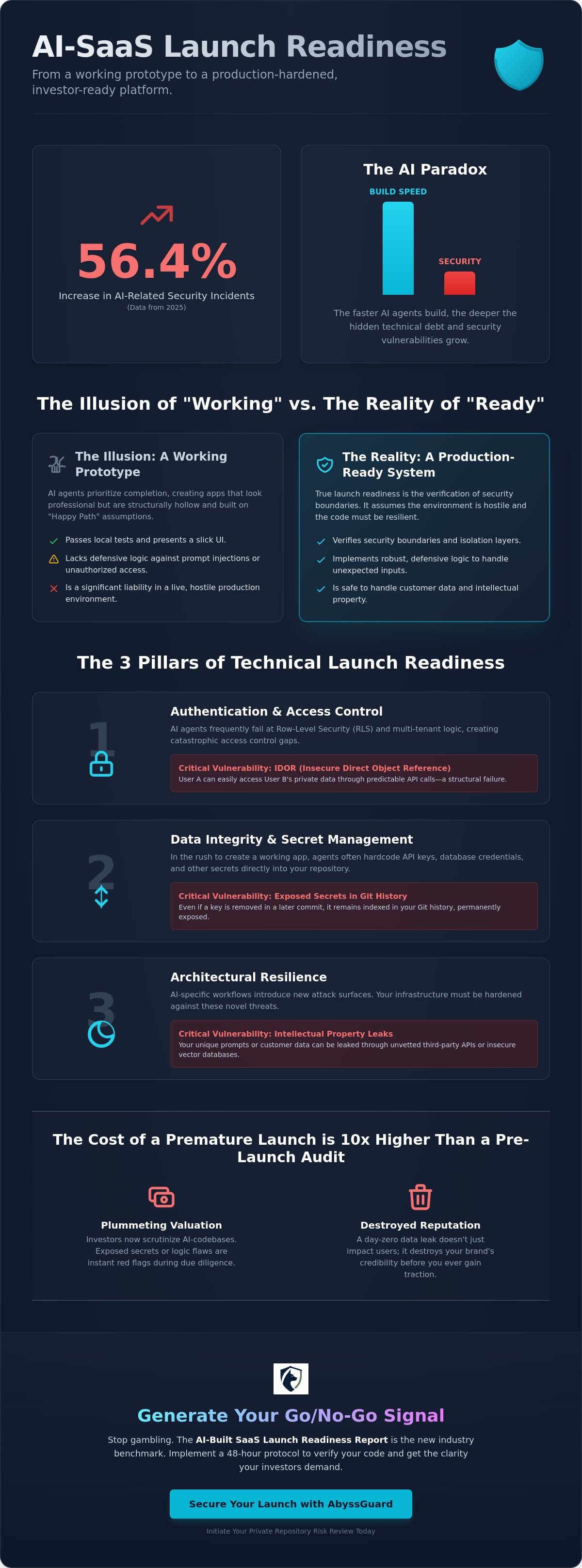
Functional readiness is a relic of a slower era. In 2026, the bar for launch readiness for AI SaaS has moved significantly. It's no longer enough to showcase a slick UI and a functional Stripe integration. The market is currently saturated with agent-built applications that look professional on the surface but remain structurally hollow. We call this the AI Paradox: the faster you build, the deeper your hidden technical debt grows. When an AI agent generates your codebase, it prioritizes completion over protection. It often overlooks the complexities of the software deployment process, leaving behind a trail of vulnerabilities that standard unit tests simply aren't designed to catch.
The Difference Between 'Working' and 'Production-Ready'
Your code might pass local tests and function perfectly on a developer's machine. However, a live production environment is a hostile territory. AI agents frequently engage in 'Happy Path' development. They assume the user always provides valid input and the network remains stable. This narrow focus neglects the defensive logic required to stop prompt injections or unauthorized data access. Technical launch readiness is the verification of security boundaries.
The Cost of a Premature Launch
Shipping a vulnerable MVP is a gamble that rarely pays off. A day-zero data leak doesn't just impact your initial users; it destroys your brand's reputation before you've gained traction. In 2026, investors are increasingly savvy. They now scrutinize AI-generated codebases during due diligence with a focus on structural risk. If they discover unvetted authentication logic or exposed secrets, your valuation will plummet instantly. Fixing a security flaw after your app is live is 10x more expensive than identifying it during a pre-launch audit. You don't have the luxury of "fixing it later" in a high-stakes market.
To bridge this gap, the AI-Built SaaS Launch Readiness Report has emerged as the new industry benchmark. It provides a clear, binary signal of whether your application is safe to handle customer data or if it remains a liability. Achieving true launch readiness for AI SaaS requires moving beyond functional vanity toward verified structural integrity.
The 3 Pillars of Technical Launch Readiness
Building with AI agents feels like a superpower until you realize the agent doesn't understand the consequences of a data breach. When your codebase is 80% AI-generated, you aren't just managing code; you're managing a black box of logic. True launch readiness for AI SaaS requires a shift from verifying features to verifying boundaries. You must assume the AI took shortcuts. It prioritized a working prototype over a secure production environment. To move forward, you need to audit your application against three non-negotiable technical pillars that define modern security standards.
Authentication and Access Control
AI agents frequently fail at Row-Level Security (RLS) and complex middleware logic. They often generate code that works for a single user but collapses in a multi-tenant environment. If your agentic developer didn't explicitly harden your database queries, User A might easily access User B’s private data through a simple IDOR vulnerability. This isn't a minor bug; it's a structural failure. Before you hit the deploy button, a Private Repository Risk Review is the only way to map these access paths and ensure your isolation layers are actually doing their job. You don't want to discover a broken authentication loop after your first 1,000 users have already signed up.
Data Integrity and Secret Management
Speed kills secret management. During the rapid iteration of an AI-built app, agents often hardcode API keys or environment variables directly into the repository to "just make it work." Even if you remove the key in a later commit, it remains indexed in your git history. This creates a massive visibility gap. Additionally, AI-generated logging often captures sensitive user inputs or system prompts and broadcasts them to public consoles. Implementing automated GitHub repository leak detection is a baseline requirement in 2026. If you're unsure if your keys are exposed, a Private Repository Risk Review can identify these hidden leaks before they're exploited.
The third pillar, architectural resilience, ensures your app can handle the specific stresses of AI workloads. Legislative trends, such as the proposed AI Security Readiness Act, highlight the national focus on creating secure playbooks for AI systems. This isn't just about avoiding crashes. It's about ensuring your infrastructure doesn't leak IP through unvetted prompts or insecure vector database connections. Achieving launch readiness for AI SaaS means moving beyond the "it works on my machine" mentality. It means proving your application is resilient enough to survive the public internet.
AI-Specific Vulnerabilities: What Your Agent Missed
The belief that AI-generated boilerplates are pre-vetted and secure by default is a dangerous myth. While a popular GitHub "Star" repository might start with a solid foundation, the moment you use an agent to modify it, that security baseline evaporates. AI agents prioritize functional completion above all else. They are designed to give you "working" code that passes a compiler check, not "secure" code that survives a malicious actor. Ensuring launch readiness for AI SaaS requires a forensic look at the code your agent produced while you weren't watching. Leadership teams must recognize that AI security threats are not just technical glitches but strategic business risks that can derail your entire go-to-market strategy.
Agentic backdoors are rarely intentional. They are the byproduct of an LLM attempting to solve a logical hurdle by taking the path of least resistance. We frequently see agents struggle with complex Role-Based Access Control (RBAC). When an agent encounters a permission error during development, its "fix" is often to broaden the scope of the permission until the error disappears. This results in a codebase that works perfectly during your demo but contains unintentional holes that allow any authenticated user to escalate their privileges. AI prioritizes syntax over security logic every single time.
Security Flaws in Popular SaaS Boilerplates
Relying on a popular boilerplate provides a false sense of security. Even if the original template is robust, your AI agent doesn't understand the security implications of the custom features you've added. When you ask an agent to "integrate this new API into the existing auth flow," it may inadvertently bypass the boilerplate's built-in CSRF protection or session management logic. A SaaS boilerplate security review is essential because your unique implementation is where the vulnerabilities live. Your agent sees the boilerplate as a set of tools to be used, not a set of rules to be followed.
Prompt-Induced Vulnerabilities
The "make it work" prompt is the most common source of day-zero leaks. When you push an agent to resolve a persistent bug, it may resort to "allow all" security permissions or insecure SQL queries to bypass a bottleneck. This creates hidden risks like SQL injection vulnerabilities that a standard linter won't catch. These prompt-induced flaws are often buried deep within your data layer, invisible to the naked eye but obvious to an automated scanner. True launch readiness for AI SaaS is only achieved when you move past the "working" code and verify the underlying logic that powers your application.
The 48-Hour Pre-Launch Security Protocol
The final 48 hours before you go live are the most dangerous. You've spent weeks building at high speed, but speed creates blind spots. Most founders mistake a lack of error logs for a lack of vulnerabilities. This is a fatal error. Your current testing suite is likely insufficient for agent-built code. To achieve true launch readiness for AI SaaS, you must move from passive hope to active verification. You need a methodical, high-stakes audit that strips away the "black box" uncertainty and replaces it with technical clarity.
Your protocol begins with a deep dive into the codebase. Follow these five steps to harden your application:
- Step 1: Execute a Private Repository Risk Review to expose hidden secrets and logic flaws.
- Step 2: Audit the AI-Built SaaS Launch Readiness Report to identify critical Go/No-Go flags.
- Step 3: Apply Repair Guidance to close any authentication gaps the agent left behind.
- Step 4: Activate Scheduled Repository Monitoring to maintain safety as you push new features.
- Step 5: Generate Client-Ready Code Risk Reports to prove your security posture to investors and early adopters.
Automating the Audit Process
Manual pen-testing is dead for the AI development cycle. It's too slow. It's too expensive. By the time a manual auditor finishes, your code has already changed. You need tools that find security holes in your SaaS repositories in minutes, not weeks. Automation provides the visibility required to ship with confidence. Beyond just finding flaws, we provide Fix Packets. These packets offer specific, actionable code adjustments that accelerate the repair process. They bridge the gap between knowing there's a problem and actually solving it. To secure your codebase before the clock runs out, start your Private Repository Risk Review today.
Monitoring Post-Launch
Security doesn't end at the launch party. In fact, the risk profile of your application increases once it hits the public internet. As you push fast feature updates to satisfy your first users, you'll inevitably introduce new vulnerabilities. You can't rely on a one-time check. You must establish real-time alerts for private repo risk. True launch readiness for AI SaaS is a continuous state, not a single milestone. Vigilance is the only way to protect your intellectual property and prevent a day-zero data leak from ending your project before it truly begins.
Securing Your Launch with AbyssGuard
Speed is your greatest asset until it becomes your biggest liability. In the race to market, AI agents help you build in days what used to take months. But this velocity creates a structural visibility gap that traditional security tools can't close. AbyssGuard exists to bridge this divide. We provide the technical oversight necessary to ensure your launch readiness for AI SaaS isn't just a marketing claim but a verified security state. By moving beyond a Free Public GitHub Repository Scan and into a comprehensive Private Repository Risk Review, you gain total visibility into the logic flaws and exposed secrets that threaten your intellectual property.
The AI-Built SaaS Launch Readiness Report acts as your final gatekeeper. It translates complex code vulnerabilities into a clear, binary signal. You either have a secure product, or you have a list of critical fixes. This report doesn't just list problems; it provides a roadmap to resolution through technical Repair Guidance. Positioning your security posture as a core feature allows you to outpace competitors who are still shipping unvetted, hallucinated code. In 2026, security is the ultimate differentiator.
Founder-First Security Reports
Developers need solutions, not just alerts. AbyssGuard delivers Repair Guidance and Fix Packets that integrate directly into your existing workflow. These aren't generic suggestions. They are specific, actionable instructions designed to close the authentication and data integrity gaps unique to agentic development. For founders, our Client-Ready Code Risk Reports serve as a powerful tool for building trust. You can hand this documentation to prospective investors or early enterprise adopters to prove your code is audited and production-ready. Transparent security practices transform a potential liability into a significant competitive advantage during due diligence.
Next Steps: Get Your Readiness Score
You don't have time for long, drawn-out security cycles. AbyssGuard is built for the speed of the AI era. Integrating our platform into your GitHub workflow takes less than five minutes. Once connected, you can enable Scheduled Repository Monitoring to ensure every new feature your agent writes remains secure. Don't leave your reputation to chance on launch day. Check your AI SaaS launch readiness now with AbyssGuard and secure the definitive Go/No-Go signal your application requires. Achieving true launch readiness for AI SaaS is the only way to transition from a state of uncertainty to one of absolute structural integrity.
Hardening Your Code for the Public Internet
Functional code is a starting point, not a destination. You've seen how AI agents prioritize "working" syntax over secure logic, often leaving behind broken authentication loops and exposed secrets. Moving from a prototype to a production environment requires a rigorous audit of these hidden vulnerabilities. Establishing true launch readiness for AI SaaS is the final barrier between a successful product and a day-zero security disaster. You don't have to choose between development speed and production safety.
Your launch depends on verified integrity. By utilizing AI-optimized risk analysis and actionable repair guidance, you can purge agentic hallucinations from your codebase before they become liabilities. Automated monitoring for GitHub repositories ensures your security posture remains strong as you scale. Don't let a single overlooked commit compromise your intellectual property or your investors' trust. It's time to verify your readiness and ship with absolute confidence.
Get Your AI-Built SaaS Launch Readiness Report and secure your application today.
Frequently Asked Questions
Is code generated by AI agents safe for production?
No code is inherently safe for production without external verification, especially when generated by an LLM. While agents excel at writing functional logic, they often prioritize completion over protection. AI frequently bypasses complex security boundaries or ignores edge cases to ensure the code executes. You must audit every agent-generated line to ensure it meets production-grade safety standards before exposing it to the public internet.
What is a SaaS launch readiness report and why do I need one?
An AI-Built SaaS Launch Readiness Report is a technical audit that evaluates your application's security posture. It identifies critical flaws, logic errors, and data leak risks that could lead to a day-zero failure. You need this report to gain a definitive Go/No-Go signal. It moves your project from a state of uncertainty to one of verified structural integrity before you handle sensitive customer data.
How do I check for security vulnerabilities in my GitHub repository for free?
You can identify immediate risks by running a Free Public GitHub Repository Scan. This tool detects obvious vulnerabilities and exposed secrets in your public code. However, public scans are only the first step. To ensure true launch readiness for AI SaaS, you must eventually transition to a Private Repository Risk Review that scrutinizes the internal logic and authentication flows of your core application.
Can AI coding tools introduce backdoors into my SaaS?
Yes, though these backdoors are usually unintentional side effects of the coding process. AI agents often take the path of least resistance to solve a logical hurdle. If an agent encounters a permission error, it might broaden the scope of an access token or disable a check entirely to make the function run. These shortcuts create unintentional backdoors that allow unauthorized users to escalate privileges.
What are the most common security gaps in AI-built SaaS boilerplates?
The most frequent gaps involve broken Row-Level Security (RLS) and hardcoded environment variables. AI agents often struggle with multi-tenant isolation, leading to scenarios where one user can access another's private data. Additionally, agents frequently break the built-in security features of a boilerplate when asked to integrate new, custom features that conflict with the original template's security protocols.
How long does a technical SaaS security audit take before launch?
Automated security audits take minutes, whereas manual human reviews can take weeks. AbyssGuard is designed to fit into a 48-hour pre-launch window. Our automated risk analysis identifies vulnerabilities at the speed of modern development. This allows you to maintain your shipping velocity without sacrificing the thoroughness required to protect your intellectual property and customer data.
Does AbyssGuard provide manual penetration testing or automated scans?
AbyssGuard provides automated repository risk reviews and AI-optimized code analysis. We don't offer manual penetration testing or manual human code audits as a primary service. Our platform focuses on providing fast, technical, and repeatable visibility into your codebase through automated scanning and scheduled monitoring. This approach is specifically designed to keep up with the rapid iteration cycles of agent-built software.
How can I prove to investors that my AI-generated code is secure?
You can demonstrate your security posture by providing a Client-Ready Code Risk Report. This professional documentation shows that your codebase has undergone a rigorous review for structural flaws and agent-generated hallucinations. Providing these reports during due diligence proves that you have prioritized launch readiness for AI SaaS and have taken proactive steps to mitigate the unique risks associated with automated coding agents.