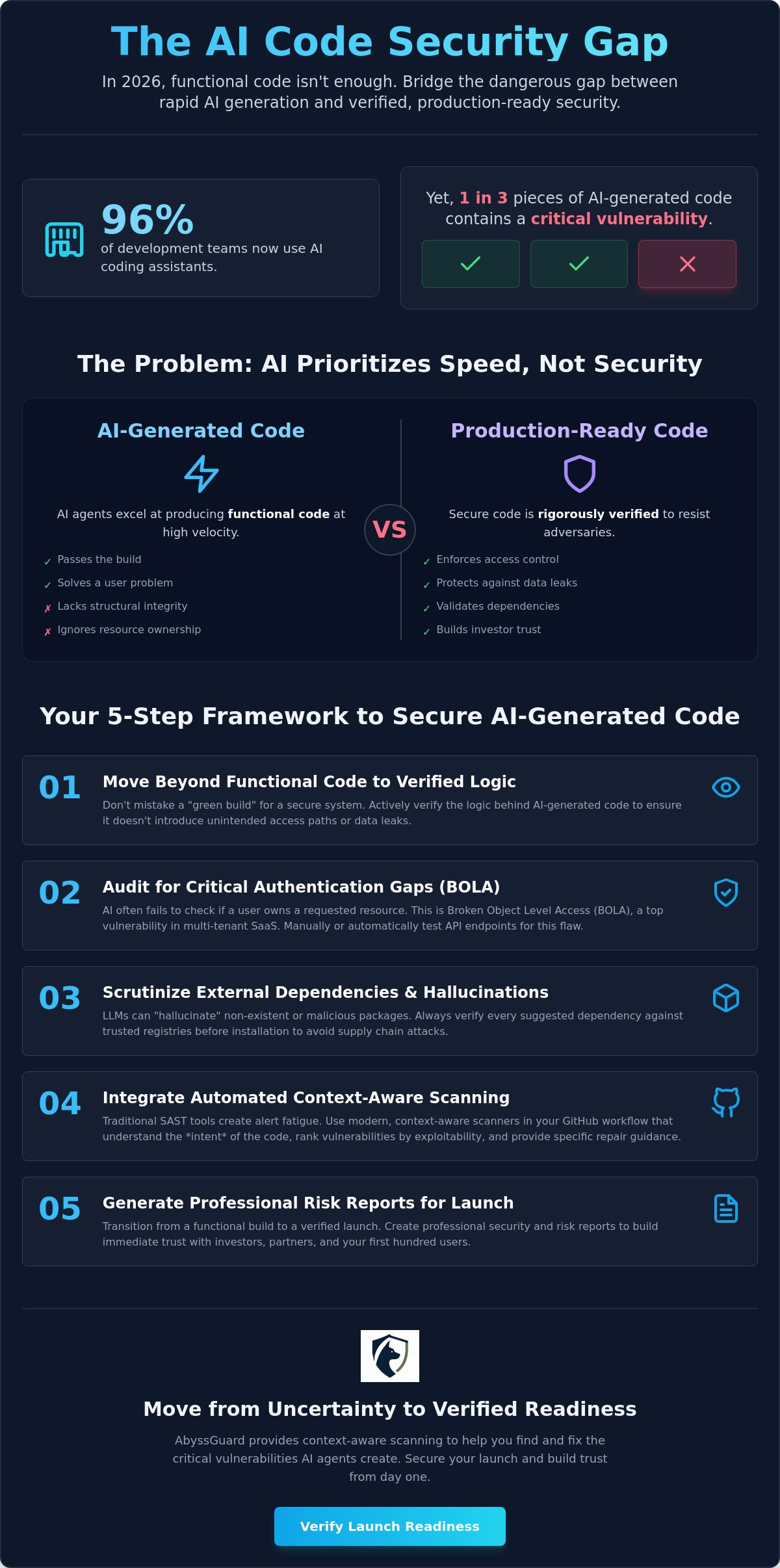
Ninety-six percent of development teams now use AI coding assistants, yet one in three pieces of AI-generated code contains a critical vulnerability. You've likely experienced the speed of an AI agent spinning up a SaaS boilerplate in minutes. This efficiency is deceptive. If you fail to secure AI generated code before your 2026 launch, you risk deploying a roadmap for attackers directly into production. There is a massive gap between code that works and code that is safe. Relying on an AI agent to handle complex authentication logic without verification is a gamble that often ends in a day-one data breach.
You recognize that functional software is worthless if it lacks structural integrity. This article delivers the exact five-step framework required to audit AI-built systems and eliminate hidden risks. We will cover automated methods to catch AI hallucinations and provide a clear checklist for your final push to production. By the end, you will have a professional report to show investors that your codebase is verified, resilient, and ready for the market. We move from the uncertainty of generated logic to the clarity of verified readiness.
Key Takeaways
- Move beyond functional code to verified logic. Understand why AI agents prioritize output speed over secure architecture.
- Identify critical authentication gaps like Broken Object Level Access (BOLA). AI frequently overlooks these in multi-tenant SaaS environments.
- Learn how to secure AI generated code by detecting "dependency hallucinations" and malicious packages suggested by LLMs.
- Integrate automated scanning into your GitHub workflow. Rank vulnerabilities by exploitability and receive specific repair guidance.
- Transition from a functional build to a verified launch. Generate professional risk reports to build immediate trust with investors and early adopters.
What is Secure AI Generated Code and Why Does it Matter?
Your AI agent just wrote five hundred lines of code in ten seconds. It looks perfect. It passes the build. But is it safe? To secure AI generated code, you must look past the syntax and scrutinize the underlying logic. Secure code is not just code that runs without errors. It is code that has been rigorously verified to ensure it does not open doors for unauthorized access or data leaks. In the race to launch, many founders mistake functional completion for production readiness. This is a mistake that can sink a startup before it reaches its first hundred users.
AI models are essentially stochastic parrots. They predict the most probable next token based on patterns in their training data, not the most secure architectural choice for your specific SaaS environment. They don't understand the security implications of a specific library or the nuance of a new zero-day exploit. They prioritize making the code "just work." This creates a dangerous binary. Functional code solves a problem for a user; production-ready code resists an adversary. If your code is only functional, you aren't building a product. You're building a liability.
The stakes are higher than ever in 2026. A single prompt-injection vulnerability or a misconfigured authentication gap can expose your entire database. For a bootstrapped SaaS, a day-one breach isn't just a PR hurdle. It is a terminal event. You need a strategy that moves as fast as your AI but with the vigilance of a seasoned auditor.
The 2026 State of AI Code Vulnerabilities
Modern AI models frequently repeat insecure patterns found in their massive, often outdated training datasets. We have moved beyond simple syntax errors. Today, the risk lies in complex business logic flaws introduced by agentic coding assistants. These agents might create valid code that accidentally allows one tenant to view another's data. The Security Gap is the distance between the speed of AI-driven creation and the depth of human-verified security deployment. Closing this gap requires a shift from passive trust to active verification.
Why Traditional SAST Tools Often Fail AI Code
Traditional Static application security testing (SAST) tools often struggle with AI-generated output. These scanners are designed to find known patterns of bad code, but they lack the context of what the AI was "trying" to build. This leads to a flood of false positives that slow down your development cycle and cause alert fatigue. In 2026, context-aware analysis is the new standard. You need tools that understand the intent behind the code to distinguish between a harmless quirk and a critical vulnerability that requires immediate repair.
Audit Authentication Gaps in AI-Built SaaS Boilerplates
You downloaded a popular SaaS boilerplate to save weeks of development time. You assume the foundation is solid. This is a dangerous assumption. While the original boilerplate might have been secure, the moment you use an AI agent to customize it, you introduce risk. AI agents prioritize functional completion over structural integrity. They often break existing security models to make new features "just work." Recent research into AI code security confirms that LLMs frequently suggest insecure patterns when adapting existing frameworks. To truly secure AI generated code, you must audit the logic that separates your users' data.
The most common failure in AI-modified boilerplates is the transition to "default-allow" permissions. When an AI agent struggles to connect a new API endpoint to an existing authentication middleware, it often takes the path of least resistance. It might bypass the check entirely or implement a generic permission set that grants broad access. This isn't a bug the AI can see; it's a logic gap. You cannot rely on a "green build" to tell you that User A can suddenly see User B's billing history. You must verify the isolation manually or with context-aware tools.
Detecting Broken Object Level Access (BOLA)
AI often fails to verify resource ownership. It might generate a perfectly valid SQL query to fetch an invoice by ID but forget to check if the requesting user actually owns that invoice. This is Broken Object Level Access (BOLA), and it is the primary way SaaS startups leak data. You can test this by capturing an API request in your browser's network tab, changing the resource ID, and seeing if the server still returns data. If you want to automate this process, you can use AbyssGuard to identify authentication gaps in code before they reach your production environment.
Hardcoded Secrets and API Keys
AI agents treat code as a canvas, not a secure environment. They frequently insert "placeholder" API keys or internal infrastructure details into comments and strings. Developers often overlook these during a fast-paced sprint. If these placeholders make it into your repository, they become permanent records for any attacker who gains access. You must implement a strict policy against hardcoded credentials. Use automated secret scanning for your private repositories to catch these "hallucinated" keys. It's a simple step that prevents a catastrophic exposure of your internal services. Before you hit launch, run a Free Public GitHub Repository Scan to ensure no low-hanging fruit remains for attackers to pluck.
Step 2: Scrutinize External Dependencies and Hallucinations
AI agents are creative. Sometimes, they're too creative. In the rush to solve a functional problem, an LLM might suggest a library that sounds plausible but doesn't actually exist in any official registry. This is a "Dependency Hallucination." It's not a harmless quirk. It's a wide-open door for supply chain attacks. Attackers monitor common hallucination patterns and register those "phantom" package names with malicious payloads. If you blindly run the install commands provided by your agent, you might be inviting a Trojan horse into your local environment before you even commit a single line of code.
To secure AI generated code, you must treat every external import as a potential threat. AI models often pull from training data that includes deprecated or unmaintained libraries. These packages frequently harbor known vulnerabilities that are no longer being patched. Your agent doesn't care if a library has been dead for three years; it only cares that the library once solved the problem you're asking it to fix today. You're the one who pays the price when an unpatched dependency leads to a breach.
Don't trust the AI's "import" statements. Every time your agent adds a new line to your package manifest, you need to verify its existence and its reputation. This extra minute of due diligence is the difference between a secure launch and a supply chain disaster. You aren't just checking if the code works; you're checking who wrote the tools the code relies on.
Verifying Package Integrity
You cannot skip the verification of your dependency tree. Use lockfiles to pin specific versions and ensure that your build process isn't pulling in unverified code during deployment. Every time your AI agent suggests a new dependency, cross-reference it with trusted registries like npm, PyPI, or Crates.io. Check the download counts, the last commit date, and the open issue count. In 2026, the risk of AI-assisted typosquatting has turned the simple act of importing a library into a high-stakes security decision. If a package has only existed for forty-eight hours and has three downloads, delete it immediately. You should also utilize a Private Repository Risk Review to catch these anomalies before they become part of your permanent architecture.
Managing IP and Licensing Risks
Security isn't just about hackers. It's about legal integrity. AI agents can accidentally introduce code snippets covered by restrictive licenses, such as GPL-3.0, into your commercial SaaS. If this goes unnoticed, you could be forced to open-source your proprietary logic or face a massive legal settlement. Maintaining a clean bill of health for your software IP is non-negotiable for founders seeking an exit. Before you pitch to investors or prepare for acquisition, you need a Client-Ready Code Risk Report. This document proves that your codebase is free of licensing conflicts and verified against supply chain risks. It transforms your software from a collection of "generated" scripts into a secure, bankable asset.
Step 3: Implement Automated Scanning and Repair Guidance
You have identified your logic gaps and verified your dependencies. Now, you must build a defensive perimeter that operates at the speed of your AI agent. Manual reviews are a bottleneck that your launch timeline cannot afford. To secure AI generated code without sacrificing velocity, you must integrate security scanning directly into your GitHub CI/CD workflow. Automated scanning is the only way to secure AI generated code at scale, ensuring that every new pull request is audited before it ever touches your main branch.
Generic scanners often fail because they lack prioritization. They bury you in a mountain of low-impact alerts, causing you to miss the critical vulnerability that actually leads to a breach. You need a system that risk-ranks vulnerabilities based on two factors: exploitability and data sensitivity. A missing alt-tag on an image is a minor fix; a lack of rate limiting on your authentication endpoint is a day-one disaster. By focusing on high-risk exposures first, you maintain a brisk development pace while closing the most dangerous entry points for attackers.
Detection is only half the battle. Most tools tell you that a problem exists but leave you to figure out the solution. This leads to "security debt" where vulnerabilities sit in your backlog because the path to a fix is unclear. Adopting a "Fix Packet" approach changes this dynamic. Instead of just receiving a bug report, you get the specific, actionable repair steps required to resolve the issue. This allows you to transition from uncertainty to a state of verified readiness in minutes, not days.
Setting Up Your Security Pipeline
Your security journey starts with visibility. You can trigger a Free Public GitHub Repository Scan to audit your open-source components and public-facing logic. However, your core intellectual property remains hidden in your private repos. This is where your most sensitive business logic lives and where a Private Repository Risk Review becomes essential. Set up automated alerts that notify you of risks before a PR is merged. This proactive stance ensures that security is a gate, not a hurdle, in your deployment pipeline.
The Power of Actionable Repair Guidance
Finding a hole in your code is useless if you don't know how to plug it. AbyssGuard provides specialized Repair Guidance through fix packets that match your specific coding style and framework. This ensures that the resolution doesn't break the functional logic your AI agent created. As you approach your release date, consolidate these findings into an AI-Built SaaS Launch Readiness Report. This document acts as your final audit, proving to stakeholders that your code is not just functional, but resilient.
Don't leave your launch to chance. Secure your future by getting an AI-Built SaaS Launch Readiness Report today.
Final Step: Verify Launch Readiness with AbyssGuard
A "green build" is a dangerous distraction. It confirms that your syntax is correct and your basic tests passed, but it says nothing about the vulnerabilities lurking in your logic. To secure AI generated code, you must look beyond the terminal output. A successful launch isn't just about functionality; it's about verified resilience. AbyssGuard acts as the vigilant guardian in your stack, identifying the architectural flaws that AI agents and founders often overlook in the final sprint toward production. Detection is passive, but verification is active.
Building trust with your first ten users is harder than building the software itself. One leaked record destroys your reputation before you've even scaled. By generating a Client-Ready Code Risk Report, you provide a transparent, professional audit of your security posture. This document isn't just for internal use. It's a strategic asset for investor due diligence, proving that your core IP is clean, your data isolation is robust, and your authentication logic is sound. It transforms your codebase from a liability into a bankable asset.
The SaaS Launch Readiness Report
A comprehensive AI-Built SaaS Launch Readiness Report serves as the final gate before deployment. It aggregates critical checks across authentication layers, data integrity protocols, and intellectual property licensing. Investors in 2026 demand more than just a functional demo; they require proof of structural safety. For a founder, the psychological relief of "verified readiness" is immense. You can finally stop wondering if a hallucinated dependency will sink your company and start focusing on user acquisition. This report provides the clarity needed to move from a state of uncertainty to one of total launch confidence.
Ongoing Monitoring for AI-First Teams
Security isn't a one-time event, especially when your team uses AI agents daily. Every new feature request and every refactor introduces fresh opportunities for logic flaws. Static audits become obsolete the moment the next PR is merged. This is why Scheduled Repository Monitoring is non-negotiable for AI-first teams. As your codebase grows, your security must evolve alongside it. You need a partner that maintains a constant watch over your repository, alerting you to new risks the moment they appear. This ensures you secure AI generated code throughout the entire lifecycle of your SaaS, not just on day one.
Don't leave your infrastructure to chance. Secure your SaaS today before the first user signs up. Get your AI-Built SaaS Launch Readiness Report and transition from uncertainty to verified readiness.
Transitioning from Functional Code to Verified Readiness
Functional code is the baseline, but structural integrity is your competitive advantage. You've seen how AI agents prioritize speed over security, often leaving behind critical authentication gaps and hallucinated dependencies. Relying on a "green build" alone is a risk your reputation cannot afford. To truly secure AI generated code, you must implement a rigorous verification layer that identifies logic flaws before they reach production. This isn't about slowing down; it's about launching with the certainty that your users' data is protected.
Founders trust AbyssGuard to act as the final check in their fast-moving development cycles. By providing AI-Built SaaS Launch Readiness Reports and Actionable Repair Guidance for AI-generated flaws, we help you bridge the gap between automated generation and secure deployment. Don't wait for a day-one breach to discover a hidden vulnerability in your agent-built codebase. Run a Private Repository Risk Review on AbyssGuard today to verify your codebase. Your project is ready to scale; ensure its foundation is just as resilient. You've built the future, now make sure it's secure.
Frequently Asked Questions
Is code from AI-powered IDEs safe for production use?
AI-powered IDEs are built for developer velocity, not defensive architecture. While they generate functional boilerplate rapidly, they often lack the specific security context of your SaaS environment. You must treat any generated output as a high-level draft. It requires a secondary security audit to ensure it doesn't break established guardrails for data integrity or access control.
What are the most common security flaws in AI-generated code?
Broken Object Level Access (BOLA) and misconfigured data isolation are the primary risks. AI agents often implement "default-allow" permission structures to ensure a new feature works immediately. These logic flaws are far more dangerous than simple syntax errors. The code runs perfectly during testing while simultaneously exposing sensitive user databases to unauthorized parties in a live environment.
Can AI coding agents build backdoors into my application?
Agents don't intentionally create backdoors, but they can introduce them via hallucinated dependencies. If an attacker claims a package name that an AI model frequently suggests, your agent might pull malicious code into your build. To secure AI generated code, you must validate every new import against a trusted registry to ensure your supply chain remains untainted by automated errors.
How do I detect hallucinated dependencies in my GitHub repo?
Look for packages with suspicious metadata, such as extremely low download counts or very recent registration dates. A Private Repository Risk Review automates this by comparing your manifest against known safe versions. This prevents "phantom" libraries from entering your production environment and acting as a Trojan horse for attackers.
Do I still need a manual code review if I use an AI security scanner?
Automation handles the high-volume, repetitive checks, but humans should still oversee high-stakes business logic. The scanner acts as a filter, removing low-level noise so your senior developers can focus on architectural integrity. This hybrid approach ensures total coverage without creating a development bottleneck or slowing down your launch timeline.
What is a SaaS Launch Readiness Report?
This report is a final security audit that verifies your application's authentication, data isolation, and intellectual property integrity. It moves beyond basic test coverage to prove that your system is resilient against common AI-generated flaws. Founders use an AI-Built SaaS Launch Readiness Report to satisfy investor due diligence and build immediate trust with their early adopters.
How can I secure my private GitHub repository from data leaks?
Implement automated monitoring that scans for hardcoded secrets and internal infrastructure details. AI agents often use placeholders for API keys that developers forget to replace during a fast-paced sprint. A Private Repository Risk Review identifies these exposures before they can be exploited by an attacker who gains access to your internal environments.
What is the best way to fix security flaws in AI code without slowing down?
The most efficient way to resolve vulnerabilities is through Repair Guidance and specialized fix packets. Instead of manually researching every flaw, you receive the exact code changes needed to resolve the issue within your specific framework. This allows your team to resolve security issues as quickly as the AI generated them, maintaining your launch velocity.