
Your AI coding agent just delivered a thousand lines of functional code in seconds, but it might have also handed a backdoor key to every malicious actor on the web. Functional code is not secure code. In the high-stakes race to market, it's easy to mistake a working script for production-ready infrastructure. However, the gap between "it works" and "it's safe" is where most SaaS startups collapse. You're likely feeling the intense pressure to ship fast while worrying if those AI-generated blocks contain hidden data leaks or the software supply chain failures now highlighted in the OWASP Top 10:2025.
We know that generic scanners often bury your team in alert noise that ignores the specific risks of automated logic. This article helps you evaluate a SaaS code analysis platform that cuts through the static to provide a definitive launch readiness signal. You'll discover how to select a system that offers actionable repair guidance and generates investor-ready security documentation. We'll preview the essential features that transform vulnerable scripts into a resilient SaaS foundation, moving your project from a state of uncertainty to verified readiness.
Key Takeaways
- Distinguish between simple functional scripts and production-ready infrastructure by analyzing deep logic and authentication flows.
- Evaluate how a modern SaaS code analysis platform prevents catastrophic data leaks by detecting secrets and API keys before they reach public repositories.
- Move beyond disconnected point solutions to a unified "Security Graph" that maps vulnerabilities across your entire code and dependency landscape.
- Secure your development lifecycle with continuous repository monitoring and actionable repair guidance that provides clear steps to fix flaws fast.
- Transition from AI-generated uncertainty to verified stability using an AI-Built SaaS Launch Readiness Report designed for investor-level scrutiny.
What is a SaaS Vulnerability Management Platform?
A SaaS vulnerability management platform is more than a simple debugger or a basic linter. It is a specialized software suite engineered to identify, prioritize, and remediate the architectural flaws that standard tools often overlook. While a basic linter checks for syntax errors, a robust SaaS code analysis platform investigates the underlying logic of your authentication flows and the integrity of your data handling. It provides a centralized dashboard that monitors your repository health throughout the entire development lifecycle. This ensures that speed never compromises the structural safety of your application.
For founders and lead developers, this platform acts as a technical auditor. It bridges the gap between a functional prototype and a production-ready infrastructure. It doesn't just flag errors; it provides the context needed to understand how a specific line of code affects your overall security posture.
The Difference Between SAST, SCA, and SaaS Security
Modern security requires a multi-layered approach that addresses different layers of the codebase. Static application security testing (SAST) focuses on your proprietary source code, scanning for vulnerabilities while the code is at rest. Software Composition Analysis (SCA) complements this by identifying risks within your third-party libraries and dependencies. However, generic tools often fail because they lack SaaS-specific context. They might miss broken access controls or data exposure risks embedded in common SaaS boilerplates. These templates often look correct to a general scanner but contain fundamental flaws in how they manage multi-tenant data isolation.
The Rise of AI-Generated Code Risks
AI coding agents are optimized for speed and immediate functionality, not long-term security protocols. These agents often produce working code that contains hardcoded API keys or lacks proper input validation. AI tools prioritize the path of least resistance to get a feature running. This creates a critical need for a SaaS code analysis platform that understands AI-specific coding patterns.
Common security flaws found in AI-generated SaaS boilerplates include hardcoded credentials and broken access control. AI often "hallucinates" security logic, creating a false sense of protection. You need a second pair of eyes that can detect these automated shortcuts before they become permanent backdoors in your infrastructure. Relying solely on AI to write your security logic is a high-stakes gamble that few startups can afford to lose. A dedicated platform provides the necessary final check, transforming uncertain scripts into verified, investor-ready code.
Key Components of Modern SaaS Code Analysis
A modern security stack exists in a binary state: it either protects your data or it leaves your infrastructure exposed. Relying on basic linting for a complex application is a liability. A professional SaaS code analysis platform must provide a multi-layered defense that addresses the specific vulnerabilities of cloud-native environments. It isn't enough to find syntax errors; you must identify the structural gaps that allow unauthorized data access. These platforms serve as a vigilant guardian, ensuring that every line of code, whether human-written or AI-generated, meets rigorous production standards.
To achieve verified readiness, your security framework should include these four core pillars:
- Automated Security Scanning: Real-time detection of the OWASP Top 10:2025 vulnerabilities, including software supply chain failures and the mishandling of exceptional conditions.
- Secret Detection: Continuous monitoring to prevent API keys, database credentials, and private tokens from ever hitting your repositories.
- Dependency Risk Management: Vigilant tracking of third-party libraries to block "poisoned" packages before they compromise your SaaS stack.
- Logic and Authentication Review: Deep analysis of multi-tenant architectures to ensure data isolation and prevent cross-user data leaks.
Static Application Security Testing (SAST)
SAST is the engine of a high-performance SaaS code analysis platform. By analyzing code paths without execution, it uncovers deep-seated flaws that dynamic testing might miss. This "Shift Left" approach allows your team to catch bugs early in the development cycle, long before they reach production. When selecting a tool, many architects refer to NIST's list of code security analyzers to verify technical benchmarks. Effective SAST reduces alert noise by applying contextual analysis to your specific SaaS framework, ensuring that your developers spend time fixing real threats rather than chasing false positives.
Secret and Data Leak Prevention
For a fast-moving startup, accidental exposure is a primary threat. Implementing robust GitHub repository leak detection acts as your first line of defense. Malicious actors use automated bots to scrape public and private repos for hardcoded keys within seconds of a commit. Your platform must provide real-time alerts that trigger the moment a secret is detected, allowing for immediate rotation before exploitation. If you're unsure about your current exposure, you can check your repository health with a specialized scan to identify existing risks.
Securing a codebase requires more than just identifying problems; it requires a path to resolution. By integrating these components into your daily workflow, you transform a vulnerable repository into a resilient, investor-ready asset. The focus remains on moving from a state of high-risk uncertainty to one of verified, production-ready stability.
Evaluating Your Options: Point Solutions vs. Launch Readiness Platforms
Your security stack is either a cohesive shield or a collection of expensive, disconnected sensors. Early-stage founders often fall into the trap of tool sprawl, believing that more scanners automatically equal more safety. It doesn't. Choosing the right SaaS code analysis platform requires looking past individual features to the final output. If you're managing five different dashboards to secure one application, you aren't just wasting time; you're creating visibility gaps that malicious actors will exploit. You need a system that correlates data, not one that just piles it up.
Point Solutions: The Fragmentation Problem
Point solutions are designed for isolated tasks. One tool might handle Software Composition Analysis (SCA) while another focuses on basic linting. While you can consult OWASP's list of analysis tools to find high-quality individual scanners, deploying them in silos leaves your team overwhelmed. The hidden cost of fragmentation is high. Siloed data prevents you from seeing how a vulnerability in a third-party library interacts with a flaw in your custom authentication logic. This fragmentation is only appropriate for massive enterprises with the headcount to manually correlate data. For a lean startup, it's a recipe for burnout and missed risks.
Launch Readiness: The New Standard for Founders
A unified platform provides a "Security Graph." It connects your code, its dependencies, and the cloud environment where they live. This holistic view is the only way to achieve a true launch readiness signal. For a founder, a list of 500 "medium" vulnerabilities is useless noise. You need to know if your app is safe to put in front of users today. You need a platform that prioritizes actionable repair guidance over generic alerts. A list of problems is a burden; a path to a fix is an asset.
This is why the industry is shifting toward launch readiness for AI SaaS as the definitive benchmark. A readiness platform gives you a binary "Go/No-Go" signal that non-technical stakeholders can understand. When you can present a clean, professional security report to a seed investor, you aren't just showing them code. You're showing them a managed risk profile. This transparency builds the trust necessary to move from a prototype to a market-leading product. Selecting a SaaS code analysis platform that delivers this signal is the difference between shipping with confidence and shipping with a target on your back.
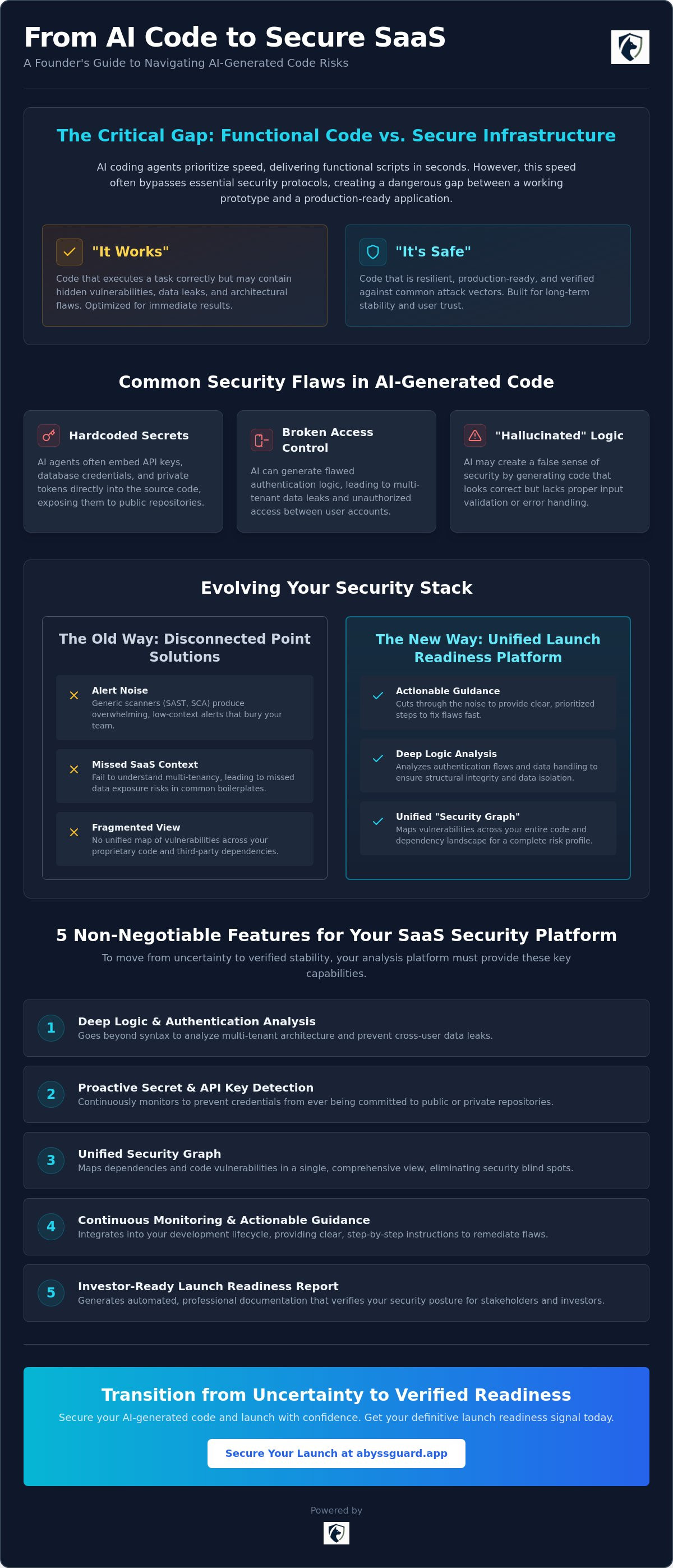
5 Non-Negotiable Features for Your SaaS Security Platform
A list of vulnerabilities is just a to-do list for your eventual breach. If your current security tool identifies a flaw but leaves you staring at a complex stack trace, it isn't a solution; it's a distraction. Selecting a professional SaaS code analysis platform requires moving beyond simple detection. You need a system that integrates with your development pace and provides clear, technical direction. For teams relying on AI coding agents, the stakes are even higher. You aren't just checking your work; you're auditing a black box of automated logic that prioritizes speed over structural integrity.
To ensure your infrastructure is truly production-ready, verify that your platform includes these five essential features:
- Scheduled Repository Monitoring: Security must live within your GitHub or GitLab workflow, providing persistent oversight rather than one-off checks.
- Repair Guidance / Fix Packets: You need step-by-step instructions or pre-configured packets to resolve identified flaws without guessing.
- AI-Native Analysis: The platform must understand the specific coding patterns and common "hallucinations" generated by agents like Cursor or GitHub Copilot.
- Client-Ready Code Risk Reports: You must be able to export professional documentation that proves your security posture to stakeholders and partners.
- Zero-Friction Integration: The setup should require minimal configuration, ensuring security never becomes a bottleneck for your development velocity.
Moving Beyond Detection to Remediation
Detection is only half the battle. A "vulnerability list" is useless without a corresponding repair plan. This is where most generic tools fail. They provide the "what" but ignore the "how." In a fast-moving SaaS environment, your team doesn't have time to research every CVE. Effective platforms provide Repair Guidance / Fix Packets that accelerate the time-to-fix for critical gaps. By balancing automated scanning with actionable remediation steps, you ensure that your developers spend their energy building features rather than deciphering security alerts. If you want to see where your current code stands, you can start a Free Public GitHub Repository Scan to identify immediate risks.
Stakeholder Transparency and Trust
Security is a powerful sales tool. Enterprise customers and investors no longer accept "we're secure" as a valid answer; they require proof. Using Client-Ready Code Risk Reports allows you to accelerate sales cycles by providing transparent, third-party validation of your codebase. These reports satisfy the rigorous due diligence requirements of funding rounds and enterprise procurement teams. Beyond the external benefits, there's a psychological impact on you as a founder. Moving from a state of "hoping it's safe" to holding an AI-Built SaaS Launch Readiness Report provides the verified confidence needed to scale. It transforms your security posture from a hidden liability into a documented asset that builds long-term market trust.
AbyssGuard: From AI-Generated Code to Production-Ready SaaS
Functional code is only the beginning of your journey. AI coding agents are excellent at building features but often fail at building walls. AbyssGuard acts as the specialized technical auditor that bridges this critical gap. As a dedicated SaaS code analysis platform, it focuses on the unique risks introduced by automated coding logic. We don't just find common bugs; we identify the architectural backdoors that generic scanners overlook. By integrating a professional SaaS code analysis platform into your workflow, you eliminate the guesswork that plagues most AI-driven projects.
Our Private Repository Risk Review is engineered to uncover the "invisible" logic flaws often embedded in popular SaaS boilerplates. These templates provide speed but frequently lack the deep data isolation required for secure multi-tenant environments. AbyssGuard analyzes how your application handles authentication and data flow, moving your project from a state of high-risk uncertainty to a verified, secure production environment. We provide the direction needed to transition from a prototype to a resilient, market-ready asset.
Audit Your Agent-Built App with Confidence
AbyssGuard specifically targets the blind spots of AI tools like Cursor or GitHub Copilot. These agents often "hallucinate" security protocols, creating logic that appears functional but fails under technical stress. You can start this process immediately by getting a Free Public GitHub Repository Scan to see how your agent-built app performs. In a recent internal audit, our platform identified critical authentication gaps in a popular SaaS boilerplate that generic tools missed entirely. This discovery prevented a potential cross-user data leak before the product ever reached its first customer.
Your Path to a Secure Launch
Achieving a secure launch requires a methodical, three-step path that replaces anxiety with verified data. This process ensures your codebase meets the high standards required by enterprise clients and savvy investors.
- Step 1: Connect your repository for a comprehensive Private Repository Risk Review to map your hidden vulnerabilities.
- Step 2: Receive your AI-Built SaaS Launch Readiness Report, providing a clear "Go/No-Go" signal for your stakeholders.
- Step 3: Execute repairs quickly using our detailed Fix Packets and Repair Guidance, ensuring every flaw is resolved correctly.
This structured approach ensures that you aren't just shipping fast; you're shipping safely. Don't let an AI-generated logic error become a post-launch catastrophe. Secure your SaaS launch today with AbyssGuard and transform your vulnerable scripts into production-ready, investor-grade infrastructure.
Secure Your Path to a Verified Launch
Functional code is an illusion of progress if it lacks structural integrity. Speed is the priority of AI coding agents, but security is the requirement of your market. By implementing a specialized SaaS code analysis platform, you bridge the gap between automated scripts and production-ready infrastructure. You have seen how unified platforms eliminate the fragmentation of point solutions, providing a clear "Security Graph" that connects your code, dependencies, and logic. Moving beyond simple detection to actionable repair guidance ensures your team spends time building features rather than deciphering alert noise.
Your security posture is now a documented asset rather than a hidden liability. With the right framework, you move from a state of high-risk uncertainty to one of verified readiness. Don't let an overlooked logic flaw or a hardcoded secret stall your momentum or alienate your investors. Audit your SaaS codebase and get your Launch Readiness Report at AbyssGuard. Our system is specialized for AI coding agents, providing AI-Built SaaS Launch Readiness Reports and Client-Ready Code Risk Documentation designed for high-stakes scrutiny. Build with speed, ship with authority, and scale your SaaS on a foundation that is truly secure.
Frequently Asked Questions
What is the difference between a standard code scanner and a SaaS vulnerability management platform?
A standard scanner identifies common syntax errors and known bugs, while a SaaS vulnerability management platform provides an integrated environment for discovery, prioritization, and remediation. It goes beyond simple flagging to provide a comprehensive SaaS code analysis platform that understands the architectural context of your application. This includes analyzing authentication flows and data isolation logic that generic tools often overlook.
Can AbyssGuard find security flaws in code generated by Cursor or GitHub Copilot?
Yes, AbyssGuard is specifically engineered to detect the unique logic flaws and "hallucinations" common in code generated by agents like Cursor and GitHub Copilot. While these tools excel at speed, they often prioritize functionality over security protocols. Our platform audits these automated scripts to ensure they don't introduce architectural backdoors or hardcoded credentials into your production environment.
How often should I run a code analysis scan on my SaaS repository?
You should implement scheduled repository monitoring to scan your codebase continuously or at every major commit. Security isn't a one-time event; it's a persistent state. Running a scan once a month leaves you exposed to vulnerabilities introduced in daily sprints. A modern SaaS code analysis platform lives within your CI/CD pipeline to catch risks before they reach production.
Do I need a security platform if I'm using a popular SaaS boilerplate?
Using a popular SaaS boilerplate doesn't guarantee security; in fact, many templates contain fundamental flaws in multi-tenant data isolation. These boilerplates are built for convenience and often lack the rigorous security checks required for enterprise-grade software. You need a dedicated audit to ensure the template's logic hasn't created "invisible" gaps that allow cross-user data leaks.
What are the most common vulnerabilities found in AI-generated SaaS code?
The most frequent vulnerabilities in AI-generated code include hardcoded API keys, broken access control, and inadequate input validation. AI agents often "hallucinate" security logic, creating the appearance of protection without the actual enforcement. These patterns lead to critical exposures that malicious actors can exploit within seconds of your code hitting a public or private repository.
How does a SaaS launch readiness report help with investor due diligence?
A SaaS launch readiness report provides third-party verification of your security posture, which significantly reduces the risk profile for investors. It transforms a vague claim of "being secure" into a documented, investor-ready asset. This transparency accelerates the due diligence process and builds the trust necessary to close funding rounds or enterprise sales cycles.
Is it safe to give a security platform access to my private GitHub repository?
It's safe when using a platform that follows industry-standard security protocols like OAuth and granular permission scoping. Access is necessary for the platform to perform a deep Private Repository Risk Review. Without this visibility, the analysis would remain surface-level, leaving your most sensitive logic and data handling flows unverified and potentially vulnerable.
Can automated tools replace a manual penetration test for my SaaS?
Automated tools cannot fully replace a manual penetration test, but they provide the continuous coverage that annual or one-off tests lack. Think of automated analysis as your daily guardian and penetration testing as a seasonal audit. For most SaaS startups, automated platforms offer the most efficient path to maintaining a consistent, production-ready security baseline between manual reviews.